Enterprise AI Agent
What if enterprise platforms had their own brain?
Background
The Problem
The Parts Full Lifecycle Platform (IDP) is Xiaomi EV's core parts management system, covering DVP (Design Verification Plan), EA (Engineering Approval), TKO (Technical Kick-Off) and other critical business processes. With 800+ users, the platform faces a growing challenge: massive amounts of repetitive operational inquiries consume the product and engineering teams' time every week.
- Product team: 1.5-2 days/week on maintenance
- Engineering team: 0.5-1 day/week on debugging
The problems are individually simple but collectively overwhelming: "How do I check part status?" "DVP is archived, can I still modify it?" "What's the EA completion rate?" "Where is the TKO process stuck?" These questions appear daily in Feishu groups and DMs, with answers often requiring cross-system investigation — reading code, querying databases, and flipping through manuals.
The Insight
"Skill is a digital encapsulation of a human workflow, and the Agent is the carrier that executes it."
As a product manager, I was dealing with user issues every day. I didn't design an AI product from scratch — I started from my own daily work. So I began writing Skills with Claude Code: first a data warehouse query script, then a manual-reading prompt, then a permission debugging workflow. After writing enough of them, I suddenly realized something: if I can encode my own work style into Skills, the Agent can "work like me." Once this logic holds, it's no longer just my tool — it becomes a personal AI assistant for everyone.
What I Did
Scenario Selection
I identified 15+ scenarios from three sources:
- High-frequency pain points — questions everyone asks daily (part status, DVP workflow, EA completion)
- Low-ROI but AI-friendly — few users ask often, but traditional investment isn't worth it; AI solves it in seconds
- Personal workflow needs — writing materials, user manuals, checking PRD gaps, querying data
I started with the scenarios that were easiest to validate and most personally useful, then expanded based on user feedback.
Standardized Workflow
I designed a main Skill (idp-debug) that orchestrates smaller Skills to complete standardized workflows. The main Skill acts as a router — it understands the user's intent, selects the right sub-Skill, and chains them together to solve the problem end-to-end.
| Scenario | Skill | Level | Core Capability |
|---|---|---|---|
| System Debug | idp-debug | Primary | Agent follows a 6-step protocol to diagnose issues, tracing from frontend → backend → data layer |
| Data Query | NL Query | Secondary | Natural language queries against the data warehouse — parts, workbenches, DVP/EA status |
| Operation Guide | Expert Skill | Secondary | 8 operation manuals embedded, generates step-by-step guides with Feishu doc links |
| Data Dashboard | UIPuff / Feishu Card Chart | Secondary | Draws beautiful dashboards based on data query results |
Technical Architecture
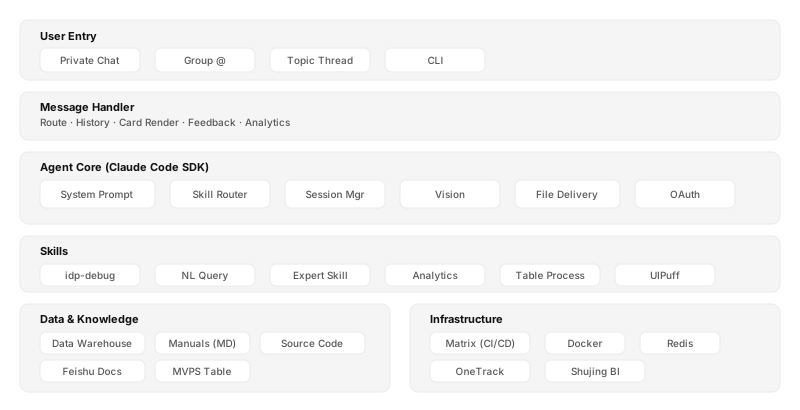
Feishu Entry: private chat, group @, topic threads;Agent Framework: Claude Code SDK, 20-turn, screenshot, file delivery;Knowledge Base: 8 manuals + schema + source code;Data: DataWorks read-only;Deploy: Matrix + Docker + CI/CD;Observability: OneTrack + Shujing BI;CLI: 106 commands
Challenges
The biggest challenge wasn't AI itself — it was integrating with enterprise infrastructure and knowledge curation:
- API availability — How to access production data? Linked the original data warehouse's query permissions and tokens.
- Source code access — Applied for read-only GitLab permissions to the business codebase, required cross-team coordination.
- Deployment — How to deploy a local Claude Code environment to production? Built a Docker + Matrix pipeline.
Moreover, simply dumping documents into AI doesn't work. We learned that structured, layered, curated knowledge is essential — garbage in, garbage out. Token cost is also a hidden killer in enterprise AI.
Product Evolution
We originally set out to build a system Q&A tool. But in the first week after launch, a project manager asked: "Can you draw an EA completion trend chart for all parts in the XX project?" That moment shifted our thinking — this isn't just a Q&A bot, it's a personal AI agent that adapts to what each user needs.
Innovation
Modular & Replicable Architecture. Instead of traditional RAG or fine-tuning, I designed a Skill-based architecture where each business capability is encapsulated as an independent Skill, and the Agent routes to the right one based on user intent. Adding a new scenario only requires writing a new Skill — no changes to the Agent core. I then abstracted this into a "Copy to System X" operational guide (14 steps), making IDP Agent a reusable enterprise AI Agent framework that any business team can adapt.
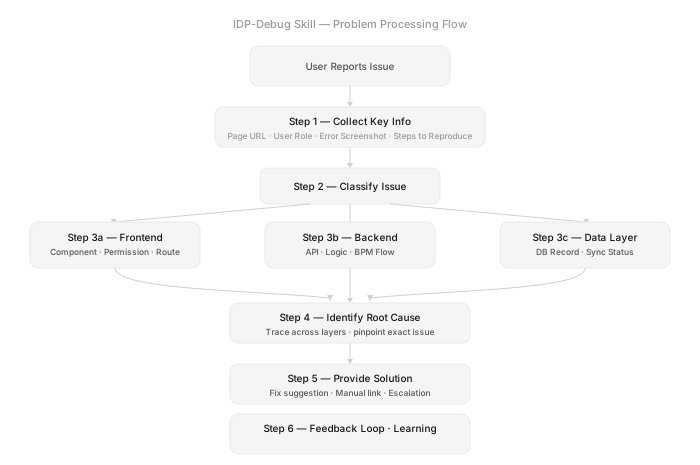
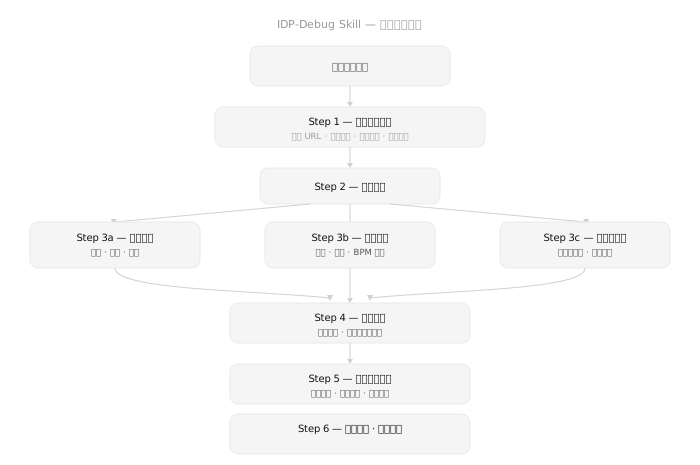
The idp-debug Skill follows a standardized 6-step workflow: collect key info → classify issue → trace frontend/backend/data layers → identify root cause → provide solution → feedback loop. This rule-based pipeline ensures consistent diagnosis quality and defines clear boundaries for what the Agent can and cannot investigate.
PM-Driven, Human-Designed. As a product manager, I independently trained the debug Skill and integrated it into the Feishu bot — breaking the assumption that "AI must be built by engineers." I also explicitly designed the Agent's boundaries: it cannot modify data, cannot operate the system on behalf of users, and complex business logic is redirected to the domain expert. Every response includes an AI disclaimer, ensuring it's understood as an assistant, not a decision-maker.
Impact
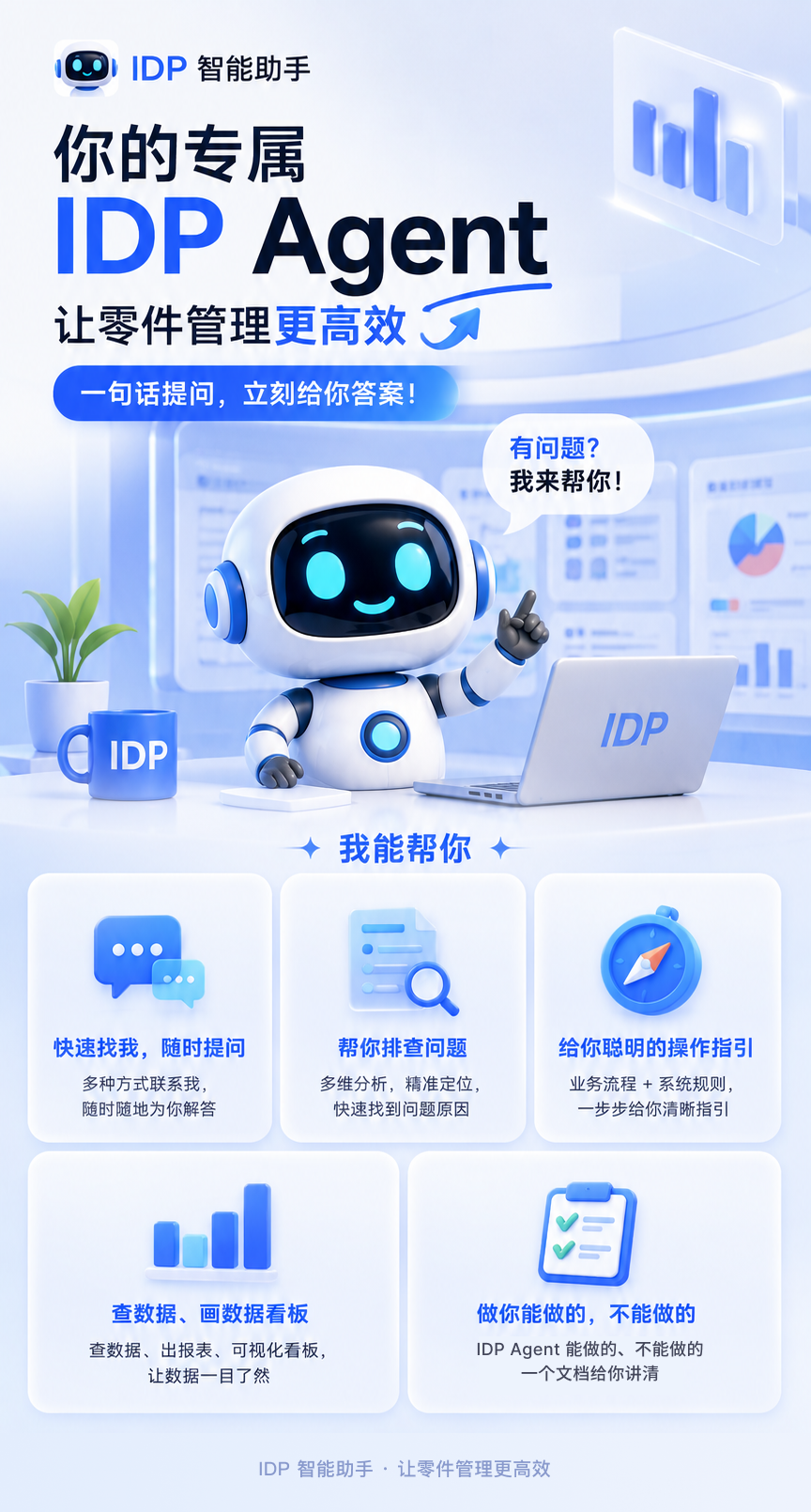
IDP Agent fundamentally changed how the team works. Problems that used to require finding someone, waiting for a reply, and cross-system investigation are now solved by asking the Agent in natural language. It supports three access modes — private chat, group @mention, and topic threads — fitting seamlessly into existing Feishu workflows.
- Problem Diagnosis: From "find someone to ask, wait for reply" → "ask Agent, instant response" with screenshot recognition and multi-turn follow-up
- Operation Guides: From "search manuals, browse docs" → "ask in natural language, get steps and Feishu links directly"
- Data Queries: From "submit request, wait for report" → "say one sentence, auto-query + generate dashboard"
Efficiency Gains
| Metric | Before | After | Improvement |
|---|---|---|---|
| Product maintenance | 1.5-2 days/week | 0.5-1 days/week | 60%+ |
| Single part query | 5+ page switches, 2-3 min | 10 seconds | 100x+ |
| Batch 10 parts query | 50+ operations, 20-30 min | 15 seconds | 100x+ |
| Manual generation | 1-2 days manual work | 10 min auto-generated | 50x+ |
| Data dashboard | R&D involvement for 1 sprint | 30 seconds | — |
We are now promoting this framework to other teams. The next frontier is Agent-to-Agent data interconnection — since many systems share connected data, once agents can communicate across systems, they become more capable than any individual human assistant.